



Risk Analytics
Develop a tailored risk-finance strategy that aligns with your organization's goals
Understanding the interplay among your organization’s risk tolerance, its specific risk profile and the current insurance marketplace is paramount to developing the most efficient risk financing strategy.
HUB Risk Analytics uses an integrated approach to provide superior risk management advice and brokerage services that seek to minimize your Total Cost of Risk by leveraging company-specific characteristics, such as past and projected loss experience, and the value of available risk financing options. Our analytical tools assess risk-bearing capacity, risk quantification and risk financing optimization to provide:
- Calculation of insurable risk-bearing capacity
- Transparent, data-based decision support
- Quantification of property, casualty, professional liability and executive risks
- Assessment of overall enterprise risk
Assess your risk tolerance, potential losses and optimal program structure with HUB's proprietary tools
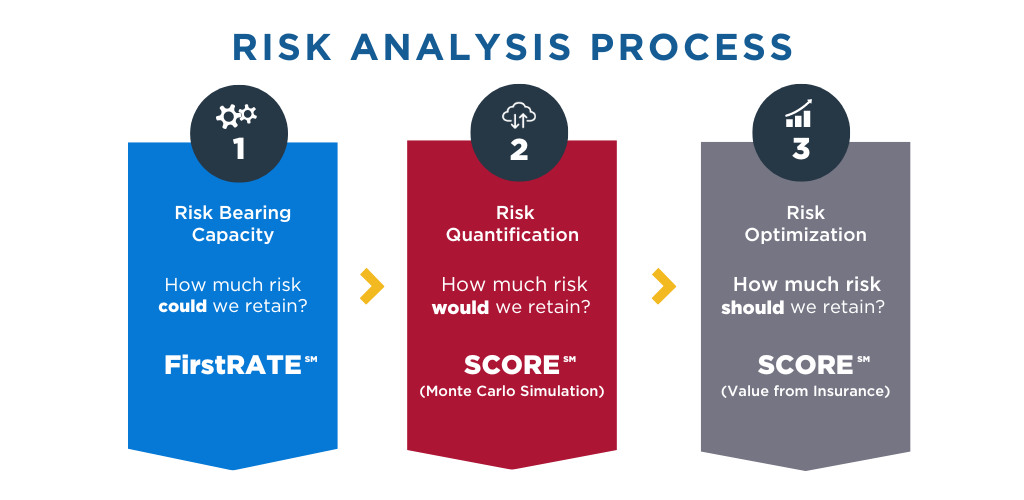
FirstRATESM (Risk Appetite and Tolerance Evaluation) is performed very early in the renewal cycle. It calculates insurable risk-bearing capacity by stress-testing the negative effect that unexpected retained losses could have on metrics indicative of an organization’s financial strength and ability to meet its business objectives.
SCORESM (Stochastic Cost of Risk Evaluation) tools take into consideration the three competing forces of risk appetite, risk profile and the insurance marketplace to determine the optimal program structure by quantifying potential losses and illustrating projected consequences of losses under various program structures.
FirstRATE and SCORE answer questions such as:
- What is my appetite or tolerance for losses from insurable risks?
- How likely is my company to incur losses?
- How detrimental can my losses become?
- What retentions should my company take?
- What limits should my company buy?
- Are the insurance premiums my company is paying fair?
- What is the optimal program structure?
SCORE tools are available for the following coverages:
- Property
- Workers Compensation
- Auto Liability
- General Liability
- Umbrella Liability
- Aviation Hull & Liability
- Hospital Professional Liability
- Lawyers Professional Liability
- Financial Services Errors & Omissions Liability
- Directors & Officers Liability
- Employment Practices Liability
- Wage & Hour
- Fiduciary Liability
- Crime
- Cyber Risk
From calculating insurable risk-bearing capacity to quantifying various risks across different coverages, our Risk Analytics FirstRATE and SCORE tools are designed to address key questions about your risk profile, arming you with comprehensive insights and actionable strategies for an optimized risk management plan. Let’s work together to develop a tailored risk-finance strategy that aligns with your organization's goals. Get started with a HUB Risk Analytics advisor today.
Risk Analytics FAQ
Risk analytics is the discipline of applying data science, actuarial modeling and financial analysis to help organizations make smarter decisions about how to identify, quantify and finance risk. In an insurance and risk management context, it moves beyond coverage placement to examine how your loss history, risk appetite and financial structure interact with the insurance marketplace. The result is data-driven risk management grounded in evidence rather than assumption — one that can be tested, measured and refined over time.
Total Cost of Risk (TCOR) represents the full financial burden of risk on an organization — including insurance premiums, retained losses, risk management administration costs and indirect costs such as lost productivity or reputational impact. Most organizations only see part of this picture. Risk analytics gives you a complete view by applying risk quantification to each component and modeling how changes to your program structure, retention levels or loss prevention investments affect your overall cost. With that visibility, you can make targeted decisions that reduce TCOR rather than simply renewing coverage year over year.
Determining the right level of risk retention requires analyzing your organization's financial strength, cash flow stability, historical loss patterns and risk appetite, not just your current deductible structure. HUB's approach uses actuarial modeling and predictive analytics to calculate your risk-bearing capacity, stress-testing different retention scenarios against your financial position. This analysis gives risk and financial managers a defensible, data-driven basis for decisions about self-insurance, captives, large deductible programs and other risk financing strategy alternatives.
Insurance program optimization decisions — retention levels, limits, layers and coverage triggers — are often made on instinct or market convention. HUB uses stochastic modeling to simulate thousands of loss scenarios and identify the program structure that minimizes your TCOR at an acceptable level of financial volatility. Risk benchmarking against peer organizations adds further context, giving you a clear picture of how your program structure compares and performs across a range of outcomes before you commit to a design.
Traditional brokerage focuses on placing coverage — negotiating terms, managing carrier relationships and processing renewals. Risk analytics asks a different set of questions: How much risk should your organization retain versus transfer? Is your current program structure the most cost-efficient option available? What does your loss data reveal about where risk management investment will have the greatest impact? HUB integrates both disciplines, using data-driven risk management and risk quantification to inform brokerage strategy rather than treating them as separate functions. The result is advice that connects your insurance program to your broader financial and operational goals.
Risk analytics is most valuable when it starts well ahead of the insurance renewal cycle, ideally six to nine months out. Beginning early allows time to gather and validate loss data, model program alternatives and engage the insurance marketplace from a position of clarity rather than urgency. When analytics are completed late in the renewal cycle, you lose the ability to act on what the data reveals. Starting early gives your organization the leverage to pursue insurance program optimization, negotiate from a position of strength and avoid reactive decisions driven by timeline pressure.
The most valuable inputs are loss runs covering five or more years, current policy schedules, financial statements and any existing risk management information. HUB works with organizations at various stages of data maturity; a complete, clean dataset is helpful but not a prerequisite. Our advisors use analytics and risk benchmarking to supplement internal data with industry comparisons and structure an analysis that delivers meaningful insights even when historical records are incomplete. The most important step is starting the conversation.
Risk financing strategy decisions — whether to buy more coverage, increase retention, explore a captive or restructure your program — involve real financial trade-offs that deserve rigorous analysis. Risk analytics provides the quantitative foundation for those decisions by applying stochastic modeling to simulate how different financing structures perform under a range of loss scenarios, market conditions and organizational constraints. Rather than relying on broker recommendations alone, your leadership team gains transparent, data-based decision support that connects risk financing choices to outcomes your organization can evaluate on financial terms.